Friday, January 17, 2014

Halong Bay and Farewell to Vietnam


Cruising among small, steep islands in a wooden boat on a beautiful bay outranked even our other adventures. Pictures tell the story.

For now, it's a sea day on the way to Hongkong. I have been using Marilyn's iPod Touch pictures for the last few posts, but can switch to my own iPad pictures for this post. There are limits to the use of an iPad in a crowded market.

Although I said I would post infrequently, I have posted several times at once because the transitions between places left little time. After a full day in Hue, for which we left at 7:45 am,

we took a 9 pm flight to Hanoi, getting to our hotel at 11, started the next day at 8:30 am, and returned to the ship in Halong at 7:30 after a four hour bus ride.

Thinking over the trip, the theme for Vietnam is change and pride. Recalling the Mekong Delta, the 73-year-old woman who owned the home factory making candy and spring roll wraps was able to build a tile house that probably replaced a minimal one on stilts. Everywhere this symptom of a prosperous family's house among humble dwellings indicates change at the individual as well as countrywide, even though many are still living as they were.

At the countrywide level, a large new airport is under constructions next to the one from which we flew. Construction and factories, many with familiar names, appear along the highway, which is itself being widened and improved, particularly in the north. For those of us in the generation that thinks of Vietnam in terms of a war that ended 40 years ago, the energetic reality is encouraging.

Thursday, January 16, 2014

Confucius and Ho Chi Minh in Hanoi

Hanoi - Confucius and Ho Chi Minh

An eleventh century pagoda sits in a corner of the vast complex containing Ho Chi Minh's mausoleum, constructed in violation of his written will to be cremated. Although the location is probably coincidental, the pagoda is consistent with his style. He rejected the elaborate building occupied by the French governor in favor of a wooden structure on stilts, also in the complex. Nevertheless, he is remembered by a huge Soviet style mausoleum.

It is becoming more widely known that Ho Chi Minh admired the United States and incorporated part of its Declaration of Independence in the Vietnamese declaration. He petitioned two American presidents for help in gaining independence from the French - Woodrow Wilson in Paris after World War I and Harry Truman after World War II - with no success. As they say, the rest is history.

Now his embalmed body rests in a Soviet style mausoleum. A couple in our group who visited it 20 years ago said the embalmed body was seated in a throne-like chair. It is now lying down. Suspicions of  Madame Tussaud's involvement have been voiced.

The partially reconstructed pagoda sits on a single column and evokes a lotus in the Buddhist tradition, another dimension of Vietnamese identity. Nearby, another eleventh century construction, the Temple of Literature, honors Confucius and his legacy, the examinations through which government administrators were selected into the time of French Indochina. The temple is another complex with ceremonial gates, courtyards and a principal temple at which people pray, despite the technicality that Confucius was a philosopher not a deity.


The temple changes the image of Hanoi whose name evokes the Vietnam War to Americans. Hanoi  was founded in 1010 and the thousand years of history, including Buddhism and Confucianism, are as much, or actually more, a part of Vietnamese identity as the mixed legacies of the French and Americans.


Hoi An and Hue - Architectural Renovation and Reconstruction


The Vietnamese, who are hurtling toward development - unfortunately mostly on recklessly driven motorbikes, are simultaneously expressing pride in the history embodied in old structures. In Hoi An, a seventeenth and eighteenth century trading port, TV aerials were ordered removed (this is a communistic country after all) and replaced with cable service.

The street environment of earlier centuries is restored even to the extent of banning motorbikes for certain hours each day.  Storefront which formerly housed trading businesses now host tourist shops and restaurants. Brides and grooms pose for wedding pictures, the brides in the traditional costume.

A traditional house owned by five generations houses a  demonstration of silk production, from worms to cocoons through spooning and weaving. We learned in a second such operation that that different types of silk emerge from different periods of boiling the cocoons. One hour produces raw silk, two a dull finish and three the smooth, shining service we associate with silk.

A striking structure is the 400-year-old "Japanese" bridge, originally built by Chinese.

In Hue, renovation and reconstruction is underway on a massive complex inspired by the Forbidden City in Beijing. Construction began in 1802, almost simultaneously with the Monroe House of the Arts Club of Washington. I occasionally reflect on the contrast of the United States in those years when Washington was a raw, muddy settlement struggling toward cityhood compared with the grandeur of European capitals.  At the same time the Vietnamese were developing an elaborate royal complex of reception halls, king and queen's palaces, administrative buildings, etc.

Ironically some of the complex's buildings were obliterated by bombing in the "American," as they call it, and French wars, but will be reconstructed.

Nha Trang - One City, Two Worlds

The site of a long sandy beach,  Nha Trang illustrates the dual characteristic of a developing nation. The modern city, created by the French in the early 19th century, is an attractive beach tourist center with 600,000 visitors a year.

Tourists come from other parts of Vietnam, neighboring countries, Russia and some Scandinavians, according to our guide.  They arrive at Nha Trang, and also at Danang, via runways built by Americans during the Vietnam War.  Attractive beachside restaurants offer lounge chairs facing the beach and some offer Russian versions of their menus.


A few miles away, a cacophony of bargaining in a densely populated covered market continues a traditional life, albeit accompanied by the continuous drone of the motorbikes at its edge. Women vendors cleave parts of animals acquired from butchers to the serving size wanted  by a customer. Vegetables, fruits, clothes and gold jewelry are offered in specific part do the market, the gold providing the bank wary a place to keep their savings.

The two worlds blend in a city market offering ranks of watches, cameras, souvenirs and clothing to everybody.  

Sunday, January 12, 2014

The Mekong Delta and another entry in the Asian architectural sweepstakes

I have to post pictures to the blog from Picasa, which is not opening via the satellite connection just now as it has done previously.  When I can open it, I will post the pictures from Marilyn that go with these comments. Future pictures from me will be taken with the iPad as I master techniques.

We visited another example of the  "more is better," Vietnamese aesthetic, a temple of a fusion religion combining Buddhism, Confucianism, Taoism and Christianity, dating from the 1920s. The same aesthetic appears over the country in five of six story narrow - because lots are narrow -  tower-like houses of those who are benefitting from the free marker approach dating from 1986. They appear bizarre to Western taste.

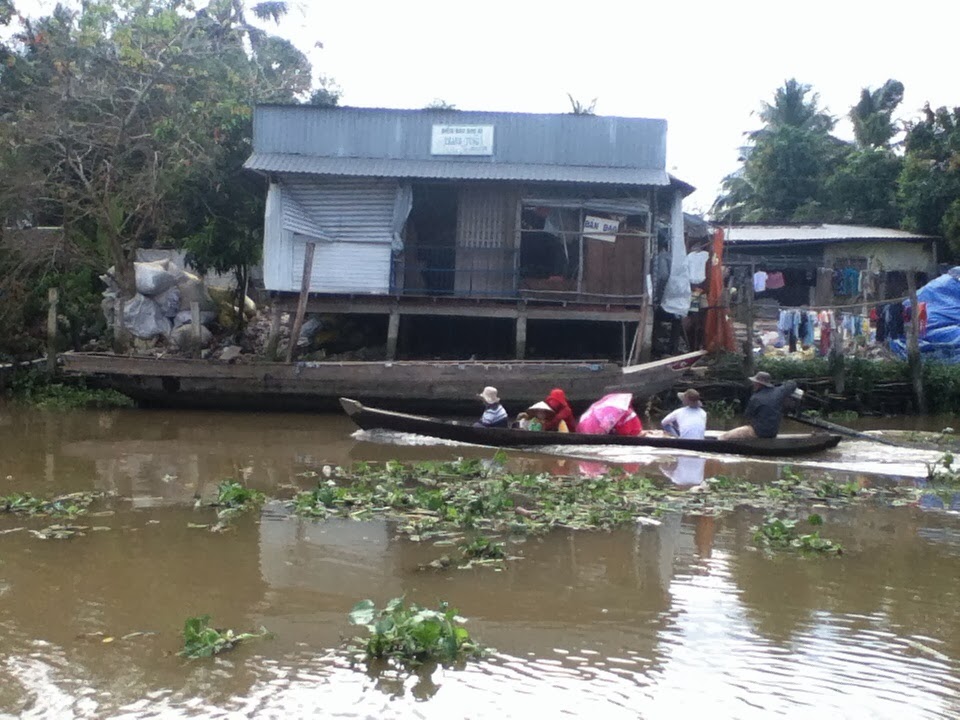
We spent a fascinating half day in the Mekong Delta along waterways that support lively communities of small producers and traders. Boats whose prows sport large eyes meant to ward off the crocodiles that previously infested the waters serve as local markets and transporters for goods to market. Shacks on stilts sit slightly over the water. Some are clearly homes; in other cases people live in more substantial houses across the road from the water and use the shacks for commerce.

A small home enterprise we visited made the rice wrappings for spring rolls and coconut candy.

 Ho Chi Minh City's entry into the Asian architectural sweepstakes is a highrise with helipad sticking out of the side two-thirds of the way up like a mushroom growing on a tree.

There may be a transportation indicator of  Asian development: feet, bicycle, motorbike, auto. Each form of movement generates its own form of urban pollution. Vietnam is definitely in the motorbike stage even if it has entered the architectural sweepstakes. 


Thursday, January 9, 2014

A misadventure in Ho Chi Minh City

Ho Chi Minh City has 10 million people and four million motorbikes. Vietnam has 90 million people and 38 million motorbikes. Two people and one motorbike have put a glitch in my blogging. While crossing a street, a motorbike came from behind me and the passenger apparently cut the strap on my bag, which I had worn safely crossbody I mistakenly thought,  and sped off with it. A nearby policeman and several bystanders chased after on foot with no result.

So no camera for awhile. Citicards will Fedex a replacement to its branch in Hanoi, where we will be in a few days. I now know that my ATM issuer, PNC bank, has no international branches. I am saved from travel penury by a Macy's credit card that is a Visa and an American Express ATM card.

Yesterday a trip through the Mekong Delta revealed that the nearby waterways are industrial in a small business way - boats painted with traditional eyes to ward off the crocodiles that formerly infested the waters serve as local markets and transport vegetables, rice husks and everything else toward the city. People operate from, and some live on, stilted shacks over the water. Others have more substantial houses across the road from the water and use the stilted shacks for fishing and trade.

Wednesday, January 8, 2014

Silk and smog in Ho Chi Minh City

We are docked in Ho Chi Minh City (Saigon) within walking distance of downtown after sailing up 37 miles of the Saigon River, an advantage of a somewhat smaller cruise ship. The river is industrial but the bad news is a city shrouded in smog. Legions of motorbikes do their bit as well. As my cabin mate Marilyn and I set out to walk downtown we discovered, as she put it, "Nobody walks in Ho Chi Minh City." Everybody rides motorbikes, which make crossing a street an adventure.

We made it to the  Rex Hotel,  whose bar was the gathering place for reporters during the Vietnam War, for lunch, walking through a street market on the way. We then had a silk road adventure along a street called Duong Khoi starting with the Rex gift shop where a nice young Kashmiri salesman improved our chic quotient by teaching us how to wear our silk scarves with flair. Properly skilled, we meandered on through high and low quality offerings and returned to the ship by taxi. This is not a city for strolls but definitely a good place for silk.