The site of a long sandy beach, Nha Trang illustrates the dual characteristic of a developing nation. The modern city, created by the French in the early 19th century, is an attractive beach tourist center with 600,000 visitors a year.
Tourists come from other parts of Vietnam, neighboring countries, Russia and some Scandinavians, according to our guide. They arrive at Nha Trang, and also at Danang, via runways built by Americans during the Vietnam War. Attractive beachside restaurants offer lounge chairs facing the beach and some offer Russian versions of their menus.
A few miles away, a cacophony of bargaining in a densely populated covered market continues a traditional life, albeit accompanied by the continuous drone of the motorbikes at its edge. Women vendors cleave parts of animals acquired from butchers to the serving size wanted by a customer. Vegetables, fruits, clothes and gold jewelry are offered in specific part do the market, the gold providing the bank wary a place to keep their savings.
The two worlds blend in a city market offering ranks of watches, cameras, souvenirs and clothing to everybody.
Thursday, January 16, 2014
Sunday, January 12, 2014
The Mekong Delta and another entry in the Asian architectural sweepstakes
I have to post pictures to the blog from Picasa, which is not opening via the satellite connection just now as it has done previously. When I can open it, I will post the pictures from Marilyn that go with these comments. Future pictures from me will be taken with the iPad as I master techniques.
We visited another example of the "more is better," Vietnamese aesthetic, a temple of a fusion religion combining Buddhism, Confucianism, Taoism and Christianity, dating from the 1920s. The same aesthetic appears over the country in five of six story narrow - because lots are narrow - tower-like houses of those who are benefitting from the free marker approach dating from 1986. They appear bizarre to Western taste.
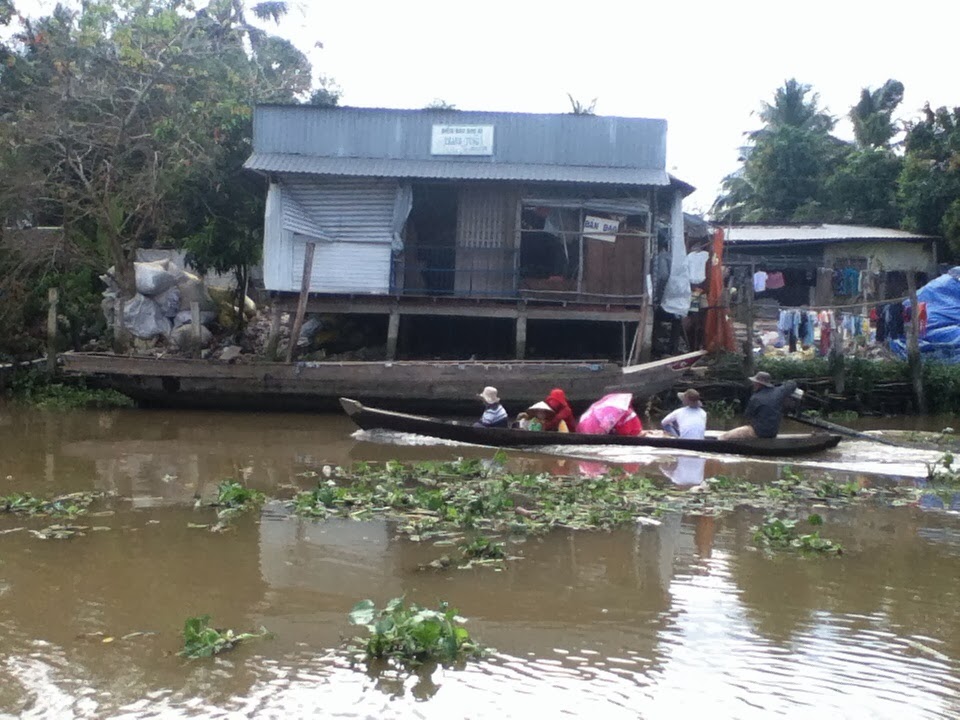
We spent a fascinating half day in the Mekong Delta along waterways that support lively communities of small producers and traders. Boats whose prows sport large eyes meant to ward off the crocodiles that previously infested the waters serve as local markets and transporters for goods to market. Shacks on stilts sit slightly over the water. Some are clearly homes; in other cases people live in more substantial houses across the road from the water and use the shacks for commerce.
A small home enterprise we visited made the rice wrappings for spring rolls and coconut candy.
Ho Chi Minh City's entry into the Asian architectural sweepstakes is a highrise with helipad sticking out of the side two-thirds of the way up like a mushroom growing on a tree.
There may be a transportation indicator of Asian development: feet, bicycle, motorbike, auto. Each form of movement generates its own form of urban pollution. Vietnam is definitely in the motorbike stage even if it has entered the architectural sweepstakes.
We visited another example of the "more is better," Vietnamese aesthetic, a temple of a fusion religion combining Buddhism, Confucianism, Taoism and Christianity, dating from the 1920s. The same aesthetic appears over the country in five of six story narrow - because lots are narrow - tower-like houses of those who are benefitting from the free marker approach dating from 1986. They appear bizarre to Western taste.
We spent a fascinating half day in the Mekong Delta along waterways that support lively communities of small producers and traders. Boats whose prows sport large eyes meant to ward off the crocodiles that previously infested the waters serve as local markets and transporters for goods to market. Shacks on stilts sit slightly over the water. Some are clearly homes; in other cases people live in more substantial houses across the road from the water and use the shacks for commerce.
A small home enterprise we visited made the rice wrappings for spring rolls and coconut candy.
Ho Chi Minh City's entry into the Asian architectural sweepstakes is a highrise with helipad sticking out of the side two-thirds of the way up like a mushroom growing on a tree.
There may be a transportation indicator of Asian development: feet, bicycle, motorbike, auto. Each form of movement generates its own form of urban pollution. Vietnam is definitely in the motorbike stage even if it has entered the architectural sweepstakes.
Thursday, January 9, 2014
A misadventure in Ho Chi Minh City
Ho Chi Minh City has 10 million people and four million motorbikes. Vietnam has 90 million people and 38 million motorbikes. Two people and one motorbike have put a glitch in my blogging. While crossing a street, a motorbike came from behind me and the passenger apparently cut the strap on my bag, which I had worn safely crossbody I mistakenly thought, and sped off with it. A nearby policeman and several bystanders chased after on foot with no result.
So no camera for awhile. Citicards will Fedex a replacement to its branch in Hanoi, where we will be in a few days. I now know that my ATM issuer, PNC bank, has no international branches. I am saved from travel penury by a Macy's credit card that is a Visa and an American Express ATM card.
Yesterday a trip through the Mekong Delta revealed that the nearby waterways are industrial in a small business way - boats painted with traditional eyes to ward off the crocodiles that formerly infested the waters serve as local markets and transport vegetables, rice husks and everything else toward the city. People operate from, and some live on, stilted shacks over the water. Others have more substantial houses across the road from the water and use the stilted shacks for fishing and trade.
So no camera for awhile. Citicards will Fedex a replacement to its branch in Hanoi, where we will be in a few days. I now know that my ATM issuer, PNC bank, has no international branches. I am saved from travel penury by a Macy's credit card that is a Visa and an American Express ATM card.
Yesterday a trip through the Mekong Delta revealed that the nearby waterways are industrial in a small business way - boats painted with traditional eyes to ward off the crocodiles that formerly infested the waters serve as local markets and transport vegetables, rice husks and everything else toward the city. People operate from, and some live on, stilted shacks over the water. Others have more substantial houses across the road from the water and use the stilted shacks for fishing and trade.
Wednesday, January 8, 2014
Silk and smog in Ho Chi Minh City
We are docked in Ho Chi Minh City (Saigon) within walking distance of downtown after sailing up 37 miles of the Saigon River, an advantage of a somewhat smaller cruise ship. The river is industrial but the bad news is a city shrouded in smog. Legions of motorbikes do their bit as well. As my cabin mate Marilyn and I set out to walk downtown we discovered, as she put it, "Nobody walks in Ho Chi Minh City." Everybody rides motorbikes, which make crossing a street an adventure.
We made it to the Rex Hotel, whose bar was the gathering place for reporters during the Vietnam War, for lunch, walking through a street market on the way. We then had a silk road adventure along a street called Duong Khoi starting with the Rex gift shop where a nice young Kashmiri salesman improved our chic quotient by teaching us how to wear our silk scarves with flair. Properly skilled, we meandered on through high and low quality offerings and returned to the ship by taxi. This is not a city for strolls but definitely a good place for silk.
Sunday, January 5, 2014
Architecture gone wild in Singapore
I expected the famous Singapore skyline with tall buildings but had not foreseen the amount of exuberant innovation because "We can," apparently. The coup de grace is the Sands hotel and casino, built for $1.5 billion dollars. It consists of three curved 50 story buildings, topped with the a horizontal building in the shape of a ship that extends along the tops of all three buildings. The ship contains gardens and a pool.
For a time taller and taller is better and better had appeared to the theme of Asian buildings. But who can compete with Dubai? Now the competition may have moved to the most creative. It seems that if something can be imagined, it will be built.
Although this is the most amazing innovation, others include a building in the shape of a lotus and a concert hall whose ceiling adjusts itself to the sound of an opera singer's voice.
Contrasting approaches to religion in Malaysia
The Malaysian population is about half Malay, all of whom are officially required to be Muslim and perhaps a quarter Chinese, many of whom who maintain Buddhist temples in the styles of south China.
The Chinese aesthetic principle is "More is better," and the "more" is in vibrant color. It occurred to me that the Greek temples were originally as colorful and may have looked more like the Chinese temples than the colorless versions familiar to us.
In the Chinese temple in Kuala Lampur, all are welcome to wander about, photography is permitted and government officials sit at desks just off the main worship area to register marriages.
In contrast, the national mosque of Malaysia, built in the 1960's, is heavily influenced by the twentieth century maxim of "Less is more." Non-Muslims and photography are limited to the forecourt of the mosque and scrutinized for adequate dress. Inadequate dress is corrected by the addition of head scarves and robes provided by the mosque. Having worn long pants and sleeves below the elbow, I was supplied with only a head scarf. Others received long purple cowled robes, making tourist groups appear to be purple European medieval monks.
Waiting signs
This is the first blog on board, the afternoon of the second day, because there was no breathing time the first day, in Kuala Lampur, and none yesterday, at Singapore.
Waiting is a significant part of air travel.The first leg of the trip involved a long wait in the San Francisco airport and the 14 hour flight to Hongkong, followed by another wait and a three hour flight to Kuala Lampur.
In San Francisco, I found a Quiet Room for reflection off in one corner of the international check-in area, nicely furnished with plants. The sign is self-explanatory. The only other person in the room was a young woman murmuring into a cell phone. I don't know if my digital camera qualifies as electronics but she didn't seem to object if I was disobeying the sign.
We were apparently fortunate because a second waiting related sign was posted in the 777 gallery on two large containers:
Snack for tarmac wait in US airport
Do not use for other purpose
Subscribe to:
Posts (Atom)